
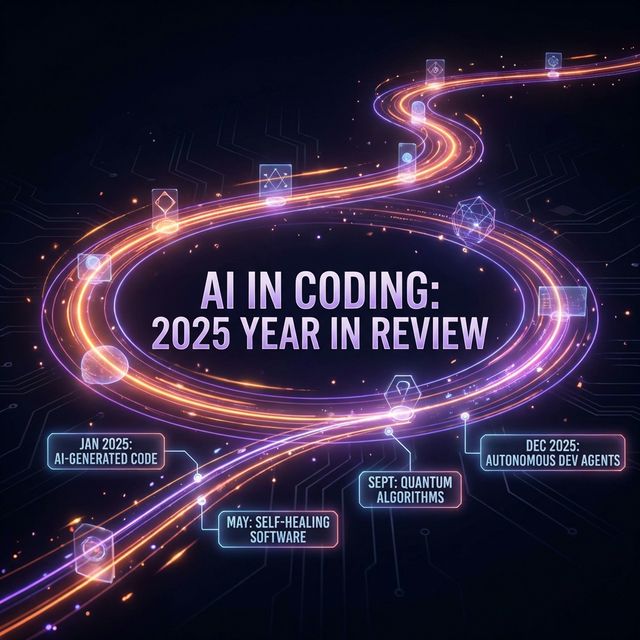
Vibecoding Year in Review: The Biggest AI Shifts of 2025
2024 was the year AI coding tools proved they were useful. 2025 was the year they proved they were essential.
Looking back over the last twelve months, the landscape of software development has shifted dramatically. The term “vibecoding” moved from a niche buzzword on Twitter/X to a recognized methodology adopted by solo founders and enterprise teams alike. We moved from simply generating code to orchestrating complex, agentic workflows.
Here is a look back at the defining moments, tools, and shifts of 2025.
1. The Consolidation of the AI IDE
At the start of 2025, developers were juggling standard text editors with browser tabs full of ChatGPT and Claude conversations. By the end of the year, the “AI-Native IDE” had become the undisputed champion of the workflow.
Cursor cemented its lead with features like Composer, proving that context-aware, multi-file editing was the killer feature everyone was waiting for. Competitors like Windsurf entered the fray, pushing the boundaries of autonomous agentic loops right inside the editor.
The debate of “Should I learn to code or prompt?” faded. The answer became obvious: You must learn how to architect systems and instruct AI to build them.
2. Claude 3.5 Sonnet: The Developer’s Darling
While OpenAI dominated the early AI conversation, Anthropic’s Claude 3.5 Sonnet (and its subsequent updates) became the unanimous favorite among developers in 2025.
Why? It possessed a unique combination of speed, immense context window capacity, and—crucially—a lack of laziness. While other models would offer truncated snippets and tell the developer to “implement the rest,” Claude was willing to output the entire robust implementation, adhering strictly to complex .cursorrules files.
3. The Rise of “One-Shot” Full-Stack Frameworks
Because AI models became so adept at scaffolding, frameworks that required heavy boilerplate saw a slight decline in favor of opinionated, batteries-included stacks.
We saw a massive resurgence in meta-frameworks like Next.js and Astro, heavily utilized by vibecoders because the AI understood their conventions perfectly. If an AI knows exactly where the routing file goes, how the data fetching works, and how to style with Tailwind, a developer can stand up a full SaaS application in days instead of weeks.
4. The “System Prompt” Became the New Resume
In 2025, your ability to configure your AI environment became as important as your GitHub commit history. We saw the rise of open-source repositories dedicated entirely to sharing optimized .cursorrules and universal system prompts.
Determining the exact phrasing to make an AI favor functional programming, avoid nested callbacks, or strictly adhere to a specific design system became a black art that everyone scrambled to master.
5. Security and Testing Caught Up
Early on, the biggest criticism of vibecoding was the sheer volume of untested, potentially insecure code it generated.
In late 2025, we saw a shift. Vibecoders began utilizing AI not just to write features, but to write comprehensive test suites. The workflow evolved:
- Generate the PRD.
- Generate the Tests (TDD with AI).
- Generate the Implementation.
- Let the AI loop until the tests pass.
Agentic CI/CD pipelines became the norm, where an AI code reviewer would automatically check PRs for security vulnerabilities and style violations before a human ever looked at them.
Looking Forward to 2026
If 2025 was about integrating AI intimately into our editors and workflows, 2026 feels poised to be the year of true autonomy. We are moving toward a reality where developers act as product managers—supervising swarms of specialized agents handling frontend, backend, database migrations, and deployments simultaneously.
The code still abides, but the way we write it will never be the same.